• Feed RSS
Showing posts with label improving medical care. Show all posts

Recently, I wrote on NPR’s Shots Blog about the movement towards open medical records and the pioneering work of OpenNotes by Dr. Tom Delbanco and Jan Walker. Here’s an excellent RWJF podcast about why they decided getting health care providers to share their notes with patients, and where their work is headed next. 

Here’s a hint: what if the 3 million patients who now have access to their clinician’s notes could co-write notes with their providers?

I'll add another thought: what if we go beyond written medical records, and patients wish to have audio- or video-tapes of their doctors' visits?

Patient advocates have responded very positively to the OpenNotes concept. I was curious about what doctors think of it and other movements to transparency. Emily Peters from Doximity was kind enough to help me with an informal poll of Doximity users (doctors who register to be on their site). We asked 3 questions and asked doctors to use a 1-5 scale, 1 being not at all likely to 5 being very likely. We received 113 responses:


(Please note that I have no financial with Doximity, and this poll is not meant to be a scientific study.)

I’d love to know what you think about this. Do the data surprise you? What do you think about open medical records, and patient-initiated requests to audiotape/videotape their medical encounters?


The law says yes. Prior to 1996, patients had to sue to see their own records. Since HIPAA—the Health Insurance Portability and Accountability Act—patients are guaranteed by law to have access to their records. However, the process for getting medical records is often so cumbersome that people don’t look at them, and usually not well after their medical visit.

In my medical training, I learned that the medical record is a tool for doctors to communicate with each other. But could it be harnessed as a collaborative tool for patients?

When Patients Read What Their Doctors Write

My latest NPR article discusses ongoing national experiments to provide open access to patients not only of their test results, but also their doctor’s notes. Participating doctors were initially opposed to the concept, but the results from the experiment have been striking:
·      80% of patients who saw their records reported better understanding of their medical condition and said they were in better control of their health;
·      Two-thirds reported that they were better at sticking with their prescriptions;
·      99% percent of the patients wanted OpenNotes to continue

When patients see their records, there's more trust and more accuracy. But that doesn’t mean that OpenNotes is a panacea. There are new controversies that are arising. I address them in this article, and also on Weekend Edition. Listen here for the interview with legendary journalist Linda Wertheimer.

What do you think? Should patients have full access to what their doctors write about them?

As an emergency physician used to working in busy, urban ERs, I like to think that I’m not easily surprised. The other day, someone did something that really amazed me.

Our patient was a young woman who had a headache and requested medications to take it away. On an average ER shift, we see dozens of patients with similar complaints to hers. On busy days, the evaluation and treatment become rote: take a history, do a physical exam, administer treatment, fill out paperwork, and so on and so forth.

I had finished the evaluation and was typing my note when our ER tech, Emily, came up to me. She held a baby in her arms who was gurgling and sucking his thumb.

“Do you remember this one?” she asked me.

I vaguely recalled that there was a crying baby in the room with my patient. Emily confirmed, “It’s hers. I just took the baby to give her a little break.”

Emily figured out something that I didn’t. Over the next hour, she entertained the baby while its mom slept, all the while carrying on with her other busy duties. When my patient woke up, her headache was much better.

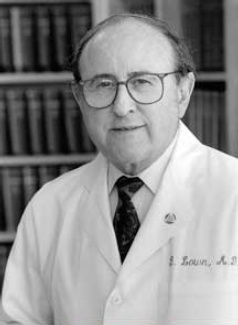
In today’s medical world, it’s so easy to forget the human aspect of care and to neglect the low-tech solutions that are so important. As my hero, Dr. Bernard Lown says, you should always feel better after having gone to see the doctor. We are so used to making people feel better through medications; we must not forget the other simpler, and even more critical treatments.

When I complimented Emily on her excellent care, she blushed. “It was nothing,” she said. (She was so hesitant to accept credit that she didn’t want her real name to be in this article.)

But it’s not nothing. It’s a bright spot, a simple act of kindness, something that can and did make a difference in someone else’s life. She didn’t do it because she wanted recognition or praise for it; she did because it was the right thing to do.

All of us have the opportunity to inject a little bit of brightness into someone else’s day. 

What will your act of kindness be? 

(Addendum: After I posted this article, the wonderful provider who was the source of inspiration for this article told me she was fine with having her first name here. Emily's real name is Dana.)

One year ago today, my book, When Doctors Don’t Listen: How to Avoid Misdiagnoses and Unnecessary Tests, was published. My goal in this last year has been to travel around the country and talk about the book and its message of advocating to improve your health. I planned a 48-city itinerary where I’d crisscross the U.S. from Massachusetts to California and back. I’d speak at bookstores, libraries, nursing homes, universities, and community centers.

What I didn’t anticipate was that this “speaking tour” would turn into a “listening tour”. 

From Boston to Los Angeles to Lexington to Cincinnati, people told me about their experiences with healthcare. Some, like 62-year old Annie from San Francisco, thought of themselves to be “e-patients”, or empowered patients. “I have a rare rheumatological illness that very few doctors have encountered,” she told me. “I bring research articles and educate my doctors.”

Others avoid doctors, like Janet, a 48-year woman from St. Louis who believes in “prevention, prevention, and prevention.” However, like many others I met, she sees healthcare providers nearly every week because she’s a caregiver to her elderly parents and her three children.

Over 2,000 people shared with me their frustrations with doctors, insurance companies, hospitals, and the healthcare system. I listened and learned.

Here are 10 themes that emerged: 

People don’t know that they have options, especially when it comes to saying no. They are used to doctors telling them what they need; they are surprised when I mentioned that patients always have a choice to NOT get a test or NOT take medications. Few interventions are so emergent that patients need to obtain them immediately. Watching and waiting, discussing it further with the doctor, and obtaining a second opinion are reasonable alternative. 

People want to please their doctors. In general, people like their doctors. Many feel they have to do what the doctor wants out of fear of displeasing them. “I lie and say I take medications I can’t afford,” 75-year Tony from San Antonio said. Others expressed their need for doctors to support their decisions. “Give me real choices and mean it,” says 38-year old Teresa. “Don’t judge me as being noncompliant just because I have a different value system.” 

People don’t want more care—they want right care. People recognize the harms of overtesting and overtreatment, and know that more care isn’t always better. They know to be wary of industries with ulterior motives. “Drug companies and insurance companies aren’t operating out of the goodness of their hearts,” says Joseph, a 55-year from Providence. “There’s a lot of money to be made money from healthcare.” They also fear rationing, and caution that less isn’t more either. What they want is the right care, without personal or commercial interests getting in the way. 

People don’t expect perfection, but they demand transparency. They know that doctors aren’t omniscient; they just want them to share what they know. Uncertainty is fine, as long as they are told the truth. Also, people accept that doctors are human and that medical errors occur. They don’t aim for retribution, but they do want disclosure of the mistake and to know that the doctor is committed to addressing it. 

People want more information to choose doctors and hospitals. “It’s disgraceful that I can find all types of information on choosing a coffee shop but I know next to nothing about my doctor,” 35-year old Jenny from Cincinnati says. People want to know about their doctors, not only their credentials, but also any financial conflicts of interests, their values, and who they are. 

People know that hospitals aren’t hotels. They don’t expect valet parking and 3-course meals, but they do want to be treated with respect. If they’re cold, they want a blanket. If they’re thirsty, they want some water. Without compassion and addressing basic human needs, marble staircases and fancy MRIs are worthless. The same goes for doctors’ offices. Forget the fancy carpeting, but find staff who treat people with humanity and dignity. 

People will wait if they get what they need. The dogma based on patient satisfaction survey results is that higher wait times leads to unhappy patients. However, the people I spoke with are unhappy not because they had to wait, but because they did not get what they expected despite the wait. “I waited two hours, and the doctor just spent five minutes with me,” said 49-year Sophie from Plymouth. Studies show that patients are interrupted in about 12 seconds; it’s no wonder people feel ignored and not listened to! 

People aren’t lazy when it comes to their health, and don’t always want the quick fix. Most people don’t want to go to their doctor at all, and prefer to find ways to improve their lifestyle and prevent disease. The popularity of diet and fitness books is case in point. Many do not want “the easy way out” in the form of drugs or surgery, but would rather discuss fitness, diet, and use of alternative therapies with their doctor. “It’s my doctor who doesn’t want to discuss these therapies with me,” says 22-year old Sandra.


With Dr. Jocelyn Elders and advocate Patty Skolnik
People know that the current system is unsustainable. No matter the politics, people saw the healthcare system as being broken, and all of them as victims—and future change agents. “It’s just like the environment: there are finite resources,” I heard over and over. Since “free” and “cheap” weren’t synonymous with good care, people are willing to pay out of pocket for better value (as long as it doesn’t bankrupt their family). They are willing to share in the cost to society, because they recognize they already are.

People crave connection and caring. They want face-to-face interaction with “their” doctor. They want to be listened to and heard. Knowing their medical history is only the start; they also want their doctors to understand and connect with them emotionally, physically, and spiritually. This requires a sustained relationship; people do not want to go to “minute clinics” or use smartphone apps to access their doctor, but rather long for a long-standing relationship with an accessible, trustworthy provider.

By no means is this list meant to be exhaustive or intended to represent every one of the individuals I met. The very nature of healthcare is that it is personal and individual. These findings represent the thoughts and wishes of a broad spectrum of people across the U.S. They challenge conventional wisdom when it comes to what is needed in healthcare. For example, the rise of urgent-care centers and smartphone apps should be seen as failure, not progress. Similarly, reducing wait times or adding fancy office furniture is not the fix for patient dissatisfaction.

Reform proposals tend to target policy changes that become mired in rhetoric and statistics. What people want is more basic, and more achievable. Doctors need to be transparency and honest with patients. They need to move away sick care towards healthcare. 

In the words of the great humanist and cardiologist Dr. Bernard Lown, we need to “do as much as possible for the patient, as little as possible to the patient.” Medical students need to learn shared decision-making and integrated care. Patients—people—should be part of every healthcare debate. Ultimately, we must restore medicine to being a caring partnership that prioritizes basic human dignity and respect. 

My listening tour continues. Please share your thoughts below. I look forward to listening and learning.

I received many responses to my NPR article on Who’s My Doctor. Many have asked what they can do. Here is a joint provider-patient petition to call for honesty and transparency in medical care. Your thoughts? If you agree, please sign here!
 

We are patients and providers who believe that doctors need to be honest, transparent, and accountable.


When we go to the doctor, we are vulnerable and need to trust that our doctors have our best interests at heart.


Doctors have to tell each other at conferences if they are paid by drug companies or medical device companies; they should also tell their patients about these potential conflicts of interest. They need to be open with patients if their employers pay them more to do more, or to do less. These incentives directly affect patient care.


We believe that informed consent isn't complete without doctors' disclosure of how their financial incentives align with their treatment recommendations.


We also believe that patients have a right to know our doctors’ views on healthcare issues such as preventive health, integrative medicine, shared decision-making, end-of-life care, and women’s health. Such beliefs can have an important impact on the provider-patient relationship, and patients need ready access to this information to be empowered to choose the right doctor for us.


Those of us who are doctors, nurses, healthcare providers, and providers-in-training affirm through Who’s My Doctor and this Total Transparency Manifesto that our patients' best interests are our best interests. We know that patients come to us at a time of vulnerability, so we will be vulnerable too. This is a partnership; we are in this together.


With this pledge, we are coming together as patients, doctors, and healthcare providers to rebuild our healthcare system into one that upholds professionalism, prioritizes patient values, and respects human dignity.

Last week, KevinMD published my article calling for participation in the new transparency campaign, Who’s My Doctor, on his highly trafficked website. Medscape also highlighted the campaign in an report. The articles drew many responses, including from some doctors who were not thrilled with the concept of transparency.


My next two blogs will report the five major themes and direct quotes, and my responses.

First is Theme 1.  If you don’t want to read the (rather entertaining) quotes, here’s the general idea: “Doctors need drug companies. We’re not influenced by them. They just pay for lunches, and I need to eat. Bedsides, it’s not my patients’ business what I do.”

“If I get some pizza from a drug rep, I'm not going to use that med for every patient regardless of need, and I don't think the patient needs to know that.”

“Do people really think I will change how I treat my patients if I am given a pen or a pizza, GOD forbid, a lunch? This whole thing is insulting to physicians and shortsighted.”

“I don’t have money or time to buy my lunch. Drug companies know that. I get food and learn some stuff, so what’s wrong with that?”

“Drug manufacturers will not uncommonly provide lunch in my office so that I can have time to discuss their medications. It is quality time because, unlike many rude physicians that I've heard about, I personally am there talking with them, instead of hidden back in my office just consuming the food.”

"I see all representatives equally and have no endearment to any one product.”


“I happen to, once a month, go to a staff meeting where a drug rep has brought in takeout food which I eat while internally rolling my eyes at their sales spiel.”


“Is the lunch that they provide me and my staff an 'association' by the NEJM's study (I had quoted a New England of Journal Medicine study that 94% of doctors have some affiliation with a drug or medical device company)? Probably. Is it inappropriate? Absolutely not. It is essential that I get the best for my patients. The lunch means that I get to eat that day while still doing that.”

“I implore all physicians to defend the freedoms of the American way of life and to do everything possible to defend the individual patient. If helping an individual patient involves learning about a new medication from a Pharmaceutical Representative, then never be ashamed to do it. Take advantage of all options, as that is the American way. Your patients deserve it.”

“The USA is still a free market society and sometimes that's how business is conducted.”

“Maybe Dr. Winn (sic) needs to move to Russia or Cuba where she can practice her style of medicine!”

Dozens of studies have shown that even small gifts affect physicians’ prescribing habits, and that doctors suffer from the “you but not me” phenomenon—where we believe our own prescription habits aren’t affected (which implies that pharma is somehow wasting their marketing efforts, a contention we know is not true).

Some have raised the point that drug reps are helpful for educational purposes, or that they need the lunch to get through their day. As a physician who invested over 14 years of my life in medical training, I find it offensive and disingenuous for doctors to say that we are interacting with drug reps "for our education". There are many free, impartial sources of information to learn evidence-based guidelines on new protocols and treatments. Drug companies are beholden not to providers, or patients, but to their stakeholders, and we as professionals (making plenty of money to buy our own lunches!), and we need to uphold our professional duties to do what's best for patients.

(For more information, there has been excellent work done in this field. See information about Healthy Skepticism, No Free Lunch, American Medical Student Association, Dr. Peter Mansfield, Dr. Joel Lexchin, Dr. Marcial Angell, Dr. Ben Goldacre, among others.)

All that said, there *might* be a difference between doctors accepting money to be a “key opinion leader” for a drug and leading a multi-site clinical trial. There are multiple websites where doctors’ affiliations with drug companies are already out in the open: ProPublica has a website, and also Accountable Care Act will have a public website in Oct 2014. Who’s My Doctor allows doctors the opportunity to explain the degree of interaction with drug companies. If you as a doctor think that your interaction with drug companies is good for you and your patients, then you have a chance to explain why.

Ultimately, the goal is not to point fingers and say that doctors who associate with drug companies (or that have investments or other specific revenue streams) are bad, but rather that our patients should know about it. Perhaps it could even be seen as a good thing that, as an oncologist, you lead large pharmaceutical-funded research studies. We need this transparency. Just as doctors disclose our conflicts of interest to each other in journals and conferences, we should disclose them to patients.

Finally, there is the issue of whether our patients should know what we are doing. The next question answers this from the standpoint of social accountability, but here’s some food for thought directly on the question of drug-company sponsorship: if doctors are taking money for something that we are ashamed of letting their patients know about perhaps it’s not something they should be doing.

Theme #2: Doctors aren’t accountable to society. We are just private citizens conducting business.


“When I became a physician, I don't recall taking an oath of poverty… Why the heck should anyone know about my investments?”


“I find it an invasion of my privacy to disclose where my income comes from. My patients don't disclose their incomes to me.”


“I'm not a public servant.”


"Maybe we can talk about accountability when all my debt has been paid off.”


“Anything that I obtained from the US taxpayers for funding of my medical education was paid back in spades."


“The individual's right of privacy is in the constitution. The "sunshine act" violates this right. Therefore the "sunshine act" is unconstitutional.”


I cite from an article for the Lancet that some colleagues and I wrote about social accountability in medicine:


“Service is the highest calling for all health professionals and, upon beginning our studies, each of us enters into social contract between our profession and the public to serve in the public’s best interest. Using physicians as a specific example, the World Health Organization defines social accountability in training as ‘the obligation to direct their education, research and service of activities towards addressing the priority health concerns of the community, region and/or nation that they have a mandate to serve.’”


Here is an excellent article about the role of physician-as-citizen.


If we are to use an economic argument, though medical students face heavy debt, our medical education is still heavily subsidized by taxpayers. Every student interviewing for medical school understands that our job is to be socially accountable to our patients and our society. They choose to enter medicine willingly, and to take the debt and our obligation willingly. We swear a Hippocratic Oath where we place patients as our first priority.


I argue that it very much is our patients’ business how we get paid, because it affects their healthcare directly.


In addition, even if you don’t believe that doctors are public servants and are just responsible to themselves, remember that disclosure is standard business practice, i.e. lawyers have to disclose their conflicts to every potential client.


Questions and comments? Please post below; I’d love to hear from you! Also, please visit our new website (open while under construction): www.whosmydoctor.com and our Facebook page.

I just returned from a thought-provoking conference at Dartmouth. Entitled Preventing Overdiagnosis: Winding Back the Harms of Too Much Care, and co-sponsored by Dartmouth University, British Medical Journal, Consumer Reports, and Australia’s Bond University, the conference raised many points that are rarely discussed.

Here are some of my favorite quotes:

“Risk factors have been turned into diseases.” Dr. Steve Woloshin discussed the absurdity of labeling us all with a “pre-disease”: doesn’t everyone all have some version of pre-hypertension, pre-diabetes, or even pre-death? More insidious is the promulgation of testing people who have no symptoms, despite of evidence of harm. American Cancer Society’s Chief Medical Officer Dr. Otis Brawley discussed how hospitals offer “free” screening tests knowing that they will lead to false positives, thus creating a market for more testing and more care.

“Diseases are being created for the purpose of selling medications.” Dr. Lisa Schwartz told the story of how GlaxoSmithKline created a new disease entity—restless leg syndrome—to find a new use of a Parkinson’s disease medication that was about to go off patent. Roy Moynihan showed his class spoof video of a new and dangerous epidemic.

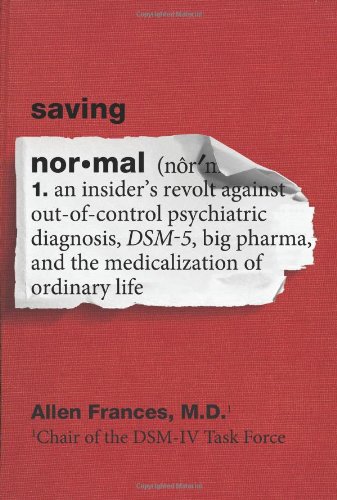
“Ordinary experience is medicalized.” Dr. Allen Frances, a psychiatrist and Chair of the DSM4 task force, rails against the psychiatric profession for labeling people with diseases they don’t have. If you are grieving two weeks after the death of a spouse, you have depressive disorder; if your child is inquisitive and energetic, he has attention deficit disorder. Of course, watchful waiting is never the solution, but fortunately, there is a new and expensive medication for this disease.

“Language corrupts thought.” A diagnosis of “carcinoma-in-situ” brings up scary connotations and fuels the desire for aggressive treatment. However, our technologies have gotten so advanced that we are detecting many early cancers that, if left alone, may never grow or harm the patient. The National Cancer Institute recently proposed a change in terminology for cancer, and other conference speakers proposed other disease definitions that should be changed.

“We are practicing faith-based medicine that ignores the harms and exaggerates the benefits.” It is well-documented that medical journals bias in favor of positive results, and that there are many financial interests to promote the newest, latest medication or treatment. Stories abound about people who survived because of early detection of disease and new, experimental treatment. However, there are also many stories of people who experience serious side effects and fatalities from overdiagnosis and overtreatment. These counternarratives need to be told, and evidence for harm needs to be published.

“Overdiagnosis is a symptom of the same problem that drives underdiagnosis and misdiagnosis.” In the discussion of overdiagnosis, it’s important not to forget that there are other pressing issues too, including medical error and lack of access to healthcare. The medical industrial complex is at fault here, too, and doctors need to assume our social responsibility and moral imperative to do what’s best for our patients.

“More care isn’t better care; it’s just more care.” In the words of my hero, cardiologist and Nobel Peace Prize winner Dr. Bernard Lown: “Overtreatment harms patients, thereby negating the first principle of doctoring, primum non nocere.” Our goal in medicine should be to do “as much as possible for the patient, as little as possible to the patient.”

There will be many challenges ahead for conference attendees, including the difficulty of framing and discussing the problems of overdiagnosis and overtreatment. Much of this conversation will continue at the Lown Institute's Right Care Alliance conference in December. My next few blog articles will address these difficulties. Stay tuned, and please feel free to contribute your thoughts below!

It was the beginning of my third year of medical school. I had just started my first clinical rotation. My very first patient was Ray, a middle-aged man with pancreatitis.

I presented his case to the team. “What are Ranson’s criteria?” the attending physician asked.

My mind went blank. “Uh, I’m not sure,” I said.

“Next time, you’d better be sure,” the attending said. He turned to my colleague, who promptly gave the correct answer.

On that first day of medical training, I learned that “I don’t know” is not an acceptable answer. If you don’t know, look it up. Make it up you have to. Whatever you do, never admit that you don’t know.

Not surprisingly, doctors end up not tolerating uncertainty. In our high-tech era, this means more is done. A patient has seemingly vague symptoms, so the doctor orders some laboratory tests “just to get a baseline”. A doctor doesn’t know what’s causing the headache, so she orders a CT or MRI “just to see”. Medical students are rewarded for pursuing obscure diagnoses, so they order increasingly esoteric tests “just in case”.

This insidious practice has resulted in a culture of overtesting and overtreatment. Studies show that 30% of all medical care—at the tune of $700 million per year—is waste. Not only does this impose a heavy financial burden on society and on patients, it also results in avoidable harm. Every test has risks and potential side effects. A CT scan has a risk of radiation, for example, that may lead to cancer later in life. And one test often leads to another, even riskier, test.

Recently, my husband had an itchy rash on his arms. He mentioned this to a dermatologist friend, who recommended that he come into the office for a skin biopsy. I asked how the biopsy would change my husband’s management: regardless of what it showed, wouldn't he still use a steroid cream? Sure, the dermatologist said, but at least we’d have more information.

Nothing against our well-intentioned friend, but this is a case where more information isn’t better. Why get a biopsy—an invasive procedure with risks including bleeding and infection—when it wouldn’t change the management or the outcome? Yet, tests are done all the time to quench the insatiable curiosity inherent in medicine: we just have to know.

Here’s another common scenario. A young woman comes in with abdominal pain. She’s able to eat and drink and looks well, but has a pain in her belly that’s bothering her. Many doctors would order a CT scan of her abdomen to make sure there’s not something bad going on. But what is this bad thing—how likely is it? How does the patient feel about the risks of the test, versus the risks of watchful waiting? If she’s fine waiting, then why expose this young person to unnecessary radiation, when it would be just as reasonable to wait to see if she gets better the next day?

More tests and better technologies are not the solution to improving clinical care. In fact, we know that 80% of diagnoses can be made without any tests at all, but by carefully listening to the patient’s story. I’m an emergency physician, yet even in the emergency setting, it is rare that a patient requires one particular test, and that test must be done right now.

Here’s what to do instead. Doctors: talk to your patients. If you’re not sure, tell them. Patients prefer honesty to false reassurance. Instead of reflexively ordering a test, discuss the benefit of the tincture of time. Remember that our first principle is to “Do no harm”. I just met two doctors, Tanner Caverly and Brandon Combs, who started an educational initiative to encourage doctors-in-training to write vignettes of medical overuse. To them, and to a growing number of physicians including the Lown Institute’s Right Care Alliance (of which I'm a proud member), preventing overuse is an ethical imperative.

Patients: insist on being an equal and active partner in your care. Ask “why” and “how”. Why is this test ordered? How will this test change my management? Make sure you know your diagnosis. Assure your doctor that it’s OK if she is not 100% sure; you don’t demand certainty, but you do expect transparency.

It’s taken me nearly ten years to unlearn the bravado I acquired in medical training and to learn that uncertainty isn’t bad; more isn’t always better; and less can be more. As the great cardiologist and humanist Dr. Bernard Lown says, you should always feel better after having gone to your doctor. We need to focus on healing by teaching and practicing the art of listening, compassion, and kindness.