• Feed RSS
Showing posts with label unnecessary tests. Show all posts

Using checklists in medical care sounds like common sense. We’ve all heard the stories of the man who had the wrong leg operated on, and the woman who had a sponge left in her belly. Checklists are routine in other professions to standardize management, and we know they can prevent hospital infections and surgical error.

But can there be a downside to checklist medical care? Consider these two examples:

Scenario 1
You come into the ER after you dove to catch a softball. You’re pretty sure you have a bruised rib, but because you said the magic words of “chest pain”, you get whisked away to get blood drawn and then to get an EKG and a chest x-ray. You’re told this is all part of the “chest pain protocol”. But did you really need all of these tests done?

Scenario 2
You tell your doctor you’re tired and feeling run down. Your doctor does “routine blood work”, again following a checklist of things to look through: anemia, thyroid problems, and so forth. Everything is “normal”. The checklist is complete, so your doctor assures you that you’re OK—even though you know you’re not.

In my work as an emergency physician, I know that checklists can be helpful. They ensure complex procedures are done thoroughly and provide an extra assurance for safety. However, before undergoing the procedure or any treatment, you must first have a diagnosis. This diagnosis, and the subsequent treatment, needs to be personalized to you. A “cookbook” approach where you get the same recipe of tests and medications as anyone else will result in expensive, unnecessary care, and even misdiagnoses and harm.


Here are five tips to make sure you get the best, personalized care for you:

#1. Insist on telling your story. Studies have shown that 80% of all diagnoses can be made based just based on the story of your illness. Doctors have limited time to listen to your story, so you must make sure your doctor understands why you’re there. Don’t just say that you have “chest pain”; explain when it started, what you were doing, and how it felt. Write down key elements. Practice until you can tell it in 30 seconds or less. Then tell it to your doctor the moment you see her to make sure the doctor focuses on your individualized story.

#2. Give open-ended responses to close-ended questions. If you suspect that the doctor is going through a checklist of yes/no questions, try to get her to focus on you by adding personal elements to your answers. If you’re asked, “when did you start feeling so tired?”, don’t just say “two weeks ago.” Add that you’re normally very energetic and run 5 miles a day, but for the last two weeks, you can barely get out of bed to work. These answers help provide context to who you are.

#3. Ask about your diagnosis before you consent to tests. If you’re told you need to get blood drawn, ask why. Sometimes, that’s enough to stop the “cookbook” from taking over. Every test should be done for a specific reason, not just because it’s what’s done in this protocol, but because it helps focus the diagnosis. Also ask about what to do if the tests are negative. Just because they’re negative doesn't mean there isn’t anything wrong, so what should be next steps?

#4. Inquire about treatment options. In very few situations is there only one test that could work or one protocol that must be followed. If your doctor says you need to do this one set of tests, ask what your other options are. Often, watchful waiting is a perfectly acceptable alternative. Discussing options helps to remind your doctor to tailor the treatment to you.

#5. Let your doctor know that you want to be a partner in your decision-making. If you still think that your doctor is following a recipe rather than individualizing care, ask her to explain her thought process to you. Say that you respect her expertise, and you want to learn what it is that she is thinking. Your doctor may be so busy or so used to checklists that your request can help her to refocus on you and your individual needs.

This article was previously published in Women's Health Magazine (posted here with their permission).

I just returned from a thought-provoking conference at Dartmouth. Entitled Preventing Overdiagnosis: Winding Back the Harms of Too Much Care, and co-sponsored by Dartmouth University, British Medical Journal, Consumer Reports, and Australia’s Bond University, the conference raised many points that are rarely discussed.

Here are some of my favorite quotes:

“Risk factors have been turned into diseases.” Dr. Steve Woloshin discussed the absurdity of labeling us all with a “pre-disease”: doesn’t everyone all have some version of pre-hypertension, pre-diabetes, or even pre-death? More insidious is the promulgation of testing people who have no symptoms, despite of evidence of harm. American Cancer Society’s Chief Medical Officer Dr. Otis Brawley discussed how hospitals offer “free” screening tests knowing that they will lead to false positives, thus creating a market for more testing and more care.

“Diseases are being created for the purpose of selling medications.” Dr. Lisa Schwartz told the story of how GlaxoSmithKline created a new disease entity—restless leg syndrome—to find a new use of a Parkinson’s disease medication that was about to go off patent. Roy Moynihan showed his class spoof video of a new and dangerous epidemic.

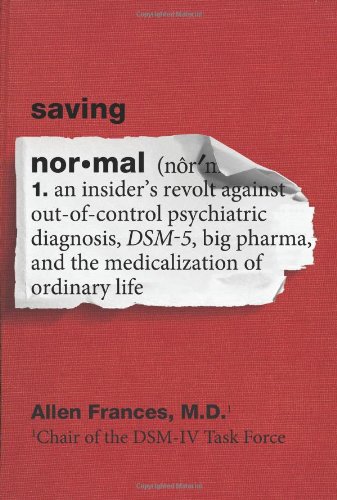
“Ordinary experience is medicalized.” Dr. Allen Frances, a psychiatrist and Chair of the DSM4 task force, rails against the psychiatric profession for labeling people with diseases they don’t have. If you are grieving two weeks after the death of a spouse, you have depressive disorder; if your child is inquisitive and energetic, he has attention deficit disorder. Of course, watchful waiting is never the solution, but fortunately, there is a new and expensive medication for this disease.

“Language corrupts thought.” A diagnosis of “carcinoma-in-situ” brings up scary connotations and fuels the desire for aggressive treatment. However, our technologies have gotten so advanced that we are detecting many early cancers that, if left alone, may never grow or harm the patient. The National Cancer Institute recently proposed a change in terminology for cancer, and other conference speakers proposed other disease definitions that should be changed.

“We are practicing faith-based medicine that ignores the harms and exaggerates the benefits.” It is well-documented that medical journals bias in favor of positive results, and that there are many financial interests to promote the newest, latest medication or treatment. Stories abound about people who survived because of early detection of disease and new, experimental treatment. However, there are also many stories of people who experience serious side effects and fatalities from overdiagnosis and overtreatment. These counternarratives need to be told, and evidence for harm needs to be published.

“Overdiagnosis is a symptom of the same problem that drives underdiagnosis and misdiagnosis.” In the discussion of overdiagnosis, it’s important not to forget that there are other pressing issues too, including medical error and lack of access to healthcare. The medical industrial complex is at fault here, too, and doctors need to assume our social responsibility and moral imperative to do what’s best for our patients.

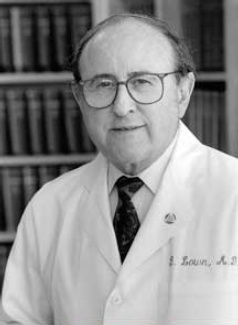
“More care isn’t better care; it’s just more care.” In the words of my hero, cardiologist and Nobel Peace Prize winner Dr. Bernard Lown: “Overtreatment harms patients, thereby negating the first principle of doctoring, primum non nocere.” Our goal in medicine should be to do “as much as possible for the patient, as little as possible to the patient.”

There will be many challenges ahead for conference attendees, including the difficulty of framing and discussing the problems of overdiagnosis and overtreatment. Much of this conversation will continue at the Lown Institute's Right Care Alliance conference in December. My next few blog articles will address these difficulties. Stay tuned, and please feel free to contribute your thoughts below!

It was the beginning of my third year of medical school. I had just started my first clinical rotation. My very first patient was Ray, a middle-aged man with pancreatitis.

I presented his case to the team. “What are Ranson’s criteria?” the attending physician asked.

My mind went blank. “Uh, I’m not sure,” I said.

“Next time, you’d better be sure,” the attending said. He turned to my colleague, who promptly gave the correct answer.

On that first day of medical training, I learned that “I don’t know” is not an acceptable answer. If you don’t know, look it up. Make it up you have to. Whatever you do, never admit that you don’t know.

Not surprisingly, doctors end up not tolerating uncertainty. In our high-tech era, this means more is done. A patient has seemingly vague symptoms, so the doctor orders some laboratory tests “just to get a baseline”. A doctor doesn’t know what’s causing the headache, so she orders a CT or MRI “just to see”. Medical students are rewarded for pursuing obscure diagnoses, so they order increasingly esoteric tests “just in case”.

This insidious practice has resulted in a culture of overtesting and overtreatment. Studies show that 30% of all medical care—at the tune of $700 million per year—is waste. Not only does this impose a heavy financial burden on society and on patients, it also results in avoidable harm. Every test has risks and potential side effects. A CT scan has a risk of radiation, for example, that may lead to cancer later in life. And one test often leads to another, even riskier, test.

Recently, my husband had an itchy rash on his arms. He mentioned this to a dermatologist friend, who recommended that he come into the office for a skin biopsy. I asked how the biopsy would change my husband’s management: regardless of what it showed, wouldn't he still use a steroid cream? Sure, the dermatologist said, but at least we’d have more information.

Nothing against our well-intentioned friend, but this is a case where more information isn’t better. Why get a biopsy—an invasive procedure with risks including bleeding and infection—when it wouldn’t change the management or the outcome? Yet, tests are done all the time to quench the insatiable curiosity inherent in medicine: we just have to know.

Here’s another common scenario. A young woman comes in with abdominal pain. She’s able to eat and drink and looks well, but has a pain in her belly that’s bothering her. Many doctors would order a CT scan of her abdomen to make sure there’s not something bad going on. But what is this bad thing—how likely is it? How does the patient feel about the risks of the test, versus the risks of watchful waiting? If she’s fine waiting, then why expose this young person to unnecessary radiation, when it would be just as reasonable to wait to see if she gets better the next day?

More tests and better technologies are not the solution to improving clinical care. In fact, we know that 80% of diagnoses can be made without any tests at all, but by carefully listening to the patient’s story. I’m an emergency physician, yet even in the emergency setting, it is rare that a patient requires one particular test, and that test must be done right now.

Here’s what to do instead. Doctors: talk to your patients. If you’re not sure, tell them. Patients prefer honesty to false reassurance. Instead of reflexively ordering a test, discuss the benefit of the tincture of time. Remember that our first principle is to “Do no harm”. I just met two doctors, Tanner Caverly and Brandon Combs, who started an educational initiative to encourage doctors-in-training to write vignettes of medical overuse. To them, and to a growing number of physicians including the Lown Institute’s Right Care Alliance (of which I'm a proud member), preventing overuse is an ethical imperative.

Patients: insist on being an equal and active partner in your care. Ask “why” and “how”. Why is this test ordered? How will this test change my management? Make sure you know your diagnosis. Assure your doctor that it’s OK if she is not 100% sure; you don’t demand certainty, but you do expect transparency.

It’s taken me nearly ten years to unlearn the bravado I acquired in medical training and to learn that uncertainty isn’t bad; more isn’t always better; and less can be more. As the great cardiologist and humanist Dr. Bernard Lown says, you should always feel better after having gone to your doctor. We need to focus on healing by teaching and practicing the art of listening, compassion, and kindness.