• Feed RSS
Showing posts with label your story. Show all posts

I am delighted to host a guest blog by writer and narrative medicine specialist Annie Robinson, who describes her journey with storytelling.

On a warm June afternoon, clustered around picnic tables, cradled in the mountains of the Berkshires in western Massachusetts, eight medical students from around the world began telling one another their stories. They were among approximately 40 students invited to participate in a weeklong intensive program run by AMSA for medical students interested in integrative medicine called LEAPS. As a graduate student of Narrative Medicine at Columbia University, I was asked to help facilitate the program.

Over iced tea and dark chocolate, they spoke of heartbreak and grief and divorce, of exam-stress and isolation and fear. They also shared brilliant visions of innovative approaches to medical care, and their aspirations to foster intimate relationships with their fellow medical students, their families and friends, and their patients. I listened with rapt attention as they described how, from personal struggles, conviction and vision were born for their careers as caregivers. I shivered, on that muggy summer day, knowing I was in the presence of my tribe. 

I was raised to revere the power of storytelling, which has been a critical component in how I have navigated my way through the world. It proved particularly useful when I entered the healthcare system in my early adolescence. I have spent over half of my life now as a patient, grappling with illnesses and issues of embodiment. In large part, it has been by speaking my struggles aloud that I have been able to heal. Telling my stories has allowed me to harness the power of the dark times to create connections and attain insight. 

As I sat there at LEAPS, witnessing medical students experiencing what I myself had experienced time and again–that relationships and wisdom come from baring one’s soul – I began to envision a way to enable more students to engage in this powerful narrative process. The seeds for my oral narratives podcast project Inside Stories: Medical Student Experiences were planted. I wanted to hear more student stories about the path to medicine, about struggles and triumphs, roadblocks and dreams. Through sharing over the course of that week, the students gained clarity and catharsis, and many remain in touch to this day. 

Inside Stories emerged from those conversations with LEAPS students. The idea was to develop a podcast platform that would enable medical students anywhere to both voice and listen to stories about medical student experience. Inside Stories’ mission is “to provide a means of personal healing, self-realization and empowerment through the sharing and receiving of personal stories, as well as to cultivate community among students in the often isolating medical school environment.” The interview process involves recording stories from current medical students, remotely or in-person. Recruitment has been done via word-of-mouth, social media platforms, and at medical humanities conferences. Student participants comprise a diverse demographic of men and women from all four years of medical school, of various races and nationalities, interested in medical fields ranging from OB/GYN to pediatrics to gastroenterology and many more. 

The topics addressed are vast. Hannah spoke about the challenges of navigating in medical school while being a mother. Petra reflected on how her spiritual path informs the challenges being a medical student. Katie discussed the encouragement she gained from finding her mentor. Leah shared how writing poetry aided her personal healing. Samar described how self-care practices helped her get through school. Angie talked about how her Syrian heritage drove her motivation to become a physician. Hieu shared his experiences as a community health worker in Uganda propelled his motivation to combat structural violence. Carlton described his motivation to pursue medicine in the South, to offer the African-American community a provider with whom they can identify.
    
To date, over 40 students have participated in the project. One participant reflected: “At first I was intimidated at the prospect of sharing my deepest feelings to a public audience, especially because I had never verbalized these feelings and in general I am a very private person. Ultimately, I'm glad I committed myself to this project and am proud to have my message out in the open.” Another described how sharing felt validating: “It made it seem real - everything that I had been through.”

I hope that by listening to the accounts of the courageous, insightful students whose stories constitute this project, others will follow suit and be inspired to share the personal stories at the heart of their journeys through the world of medicine.

If you or someone you know might be interested in telling their story about their experience in medical school, or if you have further questions about Inside Stories, please contact Annie and visit this website and on Twitter @Inside_Stories.

Have you ever had a shameful secret, something you hid from the world, something you wished more than anything that you could get rid of?

I did. Growing up, I had a severe stutter that was often so bad I couldn’t get out any words at all. One of my earliest memories is hiding in the janitor’s closet during recess so I didn’t have to talk to anyone. In second grade, I stabbed myself with a pencil so I could get out of answering in class. That piece of pencil lead is still in my leg as testament to my shame.

If only I could get over my deepest shame, my terrible fear! Surely fear is something bad, something that prevents us from reaching our goals. Yet, books and movies are filled with stories of success that only come after overcoming fear and facing adversity. So how do you select for the good parts of fear that build character rather than destroy confidence?

In February, after more than 30 years of hiding, I finally “came out” and talked about my stuttering in this TED talk. Becoming open about your deepest, darkest secret—it’s not easy. Actually, it’s downright scary to open that closet door when you spent your whole life keeping it shut. A part of me still cringes when I think of the little girl hiding in the closet with the pencil lead in her thigh. A part of me wishes I were never that little girl. Yet, I also recognize that being a person who stutters is part of my identity, like being a woman, a sister, a wife, a doctor, an Asian-American.
 
In the talk, I discuss three lessons that have helped me the most:
#1. Separate fear from shame, and take shame head on. It took me many years to learn that fear different from fear. Fear is when you are afraid of something, afraid of doing or trying something. Shame is when what you are afraid of is yourself. Hiding feeds shame, and openness is its antidote. To overcome fear, we have to first overcome shame.

#2. Tackle your “what if?” with “so what”. There are four words that plague us and feed shame and fear: what if I fail? Instead of avoid them, answer with two more: “so what?”. If there’s something you want to do, what’s the worst that will happen if you go for it? We know the answer, right? We’ve all been there. Nobody will laugh. You won’t die. As Tina Fey says, you can't be that kid standing at the top of the waterslide, overthinking it. You have to go down the chute.

#3. Ask yourself, what’s the worst that could happen if I DON’T do it? Who will it hurt? If you want to be a doctor and don’t become one because you’re too afraid, who will serve your community? If you’re afraid of speaking up to help someone in need because you’re afraid of stuttering, who will do it instead? All of us are here today because other people made sacrifices, because they faced fear head on for us. Now it’s our turn, for those who follow.

Please share  your stories: have you brought something you're ashamed about into the open? How have you turned your fear inside out?
My last blog post discussed why medicine is so intolerant of uncertainty and inaction, and how this has resulted in a culture of overtesting and overtreatment.

All of us as patients and doctors are at fault for feeding into this system of waste and harm. However, there are some active voices of resistance. Here are some examples:

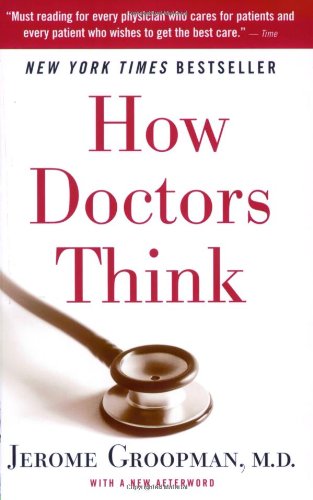
Dr. Jerome Groopman, internist and author of the excellent book, How Doctors Think, writes about how he teaches medical students to “don’t just do something—stand there.” Very few situations in medicine require immediate action. It may be uncomfortable to apply the tincture of time as a treatment, and many doctors find it easier to order a test than to discuss the pros and cons of the test with a patient.

However, we need to remember our first principle, primum non nocere: first do no harm. Dr. Abraham Verghese writes about the importance of restraint and self-awareness in his novel, Cutting For Stone. Here is the protagonist, a doctor himself, speaking about his father:

My father, for whose skills as a surgeon I have the deepest respect, says, "The operation with the best outcome is the one you decide not to do." Knowing when not to operate, knowing when I am in over my head, knowing when to call for the assistance of a surgeon of my father's caliber--that kind of talent, that kind of "brilliance," goes unheralded.

Doctors: think carefully. Engage in thoughtful discussion with your patient, and decide together what’s best for him. Remember that no testing and no treatment may be the best course of action.

If you have to do something, consider a novel treatment that Dr. Aaron Stupple coins “a listening infusion.” During his internship, Dr. Stupple faced resistance when he questioned his supervisors on the necessity of costly tests and invasive treatments. As the most junior person on the team, he couldn’t override their decisions, but he could add his own treatment. He made it a routine to visit patients and talk to them, often staying hours after everyone else to finish his “listening infusion”. He didn’t obtain more test results, but somehow he knew more about his patients than anyone else. He didn’t give them a pill, but somehow his patients felt better at the end of the day.

This is what doctoring should be about. A recent study of resident doctors found that only 12% of their time was spent interacting with patients, versus 40% interacting with the computer. The doctor may find everything about a person’s laboratory tests, but nothing about her family or values. “Personalized medicine” and “patient-centered care” are hot buzzwords, but it’s not just about finding someone’s DNA and redoing the waiting room area. Improving medical care must begin with personalizing care to the patient and listening to her story.

We must bring back the art of medicine and the art of healing, and treat all of our patients with a “listening infusion”. Then, “don’t just do something—stand there”! Changing any deeply-entrenched culture is hard, but it can happen: one doctor at a time, one patient at a time.

Steve is a 52-year old father of four. Soon after losing his job as a carpenter, he begins to have sharp stomach pains. His primary doctor examines him for a few minutes and then sends him to specialists: a GI doctor, who performs an endoscopy, and a cardiologist, who performs a cardiac catheterization. Both tests are normal, but he develops an aneurysm and a bad pneumonia, and has to spend the next week in the hospital. His medical bill is over $75,000, and Steve has to declare bankruptcy—all because of tests he never needed to begin with.

**

Sandy is a 46-year old grade school teacher who has been feeling unwell for a couple of months: she’s short of breath, feels tired all the time, and has a cough that wouldn’t go away. She goes to her doctor, who tells her it’s just a cold. Her symptoms get worse to the point she can longer go to work, and her doctor diagnoses her with depression and prescribes her some Prozac. That doesn’t help, so her doctor prescribes her Valium for her “anxiety”. It’s not until nearly a year later that she is finally diagnosed with breast cancer—cancer that, by then, has spread to her livers, her lungs, and her brain.

**

Science has brought about many importance advances, but also contributed to costly, harmful, and dehumanized medical care. Of the $2.7 trillion our country spends on healthcare every year, 30%--over $700 million—is wasted on unnecessary tests and treatments. Two out of every three families who declare bankruptcy do so because of excessive medical bills. Overtreatment isn’t just expensive, but it’s bad care. As Steve experienced, every intervention—even a simple blood test—has potential side effects. This doesn’t mean to never get tests, but rather to be certain that the test or treatment is needed.

At the same time medical costs are ballooning, healthcare has become more fragmented and less coordinated. The idea of having “your” doctor is becoming a relic of the past, and patients are shuttled to more and more specialists who have their own incentives. And medical care isn’t becoming safer: according to the Institute of Medicine, 100,000 people die every year because of medical error. The number one cause of medical error is misdiagnosis, which is evident in Sandy’s case: if the diagnosis is wrong, then the tests and the treatment will be wrong as well.
 
Politicians and administrators have proposed many solutions to these current system ailments. They are all based on the premise that more has to be done. More checklists. More tracking. More accountability. More technology. While some of these efforts may be beneficial, there is a far simpler and more fundamental reform that is needed: for patients to tell their story, and for doctors to listen.

The story is a core element of all human cultures. We all know what makes a good story: it is personal; it engages emotion; it has meaning; it grabs your attention from the start. Understanding each other’s stories is the basis for establishing connection, relationship, and trust. In medicine, the story is key to sound medical care. Studies have shown that 80% of diagnoses can be made just based on the story alone. That’s better than any test or combination of tests!

Listening to your story is also a critical aspect of healing. If your doctor didn’t listen to you, how can you be sure that he understood what you have, much less how you can develop a trusting partnership? Yet, doctors are listening less and less. A 1984 study found that patients are interrupted after just 18 seconds. A more recent study found that patients now have just 10-12 seconds to speak.

Over the last year, I have traveled to 48 cities across the U.S. to talk to people about their healthcare. Nearly everyone had a story of how not listening led to a bad outcome. That’s how I met Steve. Like many others, Steve considers himself to be lucky to be alive, but is he so lucky? He feels no better after having gone to his doctors, and now has lost his savings and his home. He suffered complications from tests he never needed in the first place, and he has no trust that doctors will do the right thing for him and his family the next time.

As for Sandy, I know her well too. You see, Sandy was my mother. I was a medical student when she called me to tell me about her symptoms and how her doctor wasn’t listening. I knew that something was wrong. My mother was an immigrant who worked hard all her life, who never complained about anything. Yet, I didn’t know how to help her communicate with her doctor so that he would really understand the gravity of her situation.

It took me a decade—first as a caregiver to my mother, and then as a practicing physician and patient advocate—to figure out that the story is absolutely fundamental to medical practice. Indeed, it can save your life.

Imagine, how different would it have been if Steve started out his story to his doctor by talking about his financial concern and his recent unemployment, how it was making him anxious and have stomach pains. How different would it have been for my mother to say that she’d never sought medical care for anything, but now she was feeling so poorly she could barely get out of bed any more.

And how different would it have been if their doctors listened. Some argue that doctors don’t have time to do so. While doctors are under more time pressure than ever before, it doesn’t take any longer to listen—in fact, it saves the time that’s wasted instead on asking endless close-ended questions and ordering unnecessary tests. Others insist that these tests have to be done because of fear of malpractice. Yet, the number one cause of malpractice is lack of communication, and patients should not have to pay the price for doctors’ fear.

I wish I learned this critical lesson a decade earlier. Not a day goes by that I don’t think about how things could have been different if my mother and I knew what I know now. As a physician and medical educator, I teach my patients and my students that what will really change medicine isn’t the latest IPhone app or newest genetic test, but rather a return to medicine as a healing art.

This requires action by both patients and doctors. Patients, tell your story. Know what goes into a compelling story. Practice it before going to your doctor, then make sure your doctor hears it. Doctors, know that you have to listen. Not just type on your computer and nod your head, but really listen.

Ultimately, transforming healthcare doesn’t require more politics or more technology. Rather, it requires refocusing on the most basic part of ourselves—our story and our human connection. This revolution, the low-tech revolution, is the real solution to healthcare reform.

Hospitals can save you, but they can also harm you. In my last two articles, I discussed recent research that shows how medical errors affect one in three hospitalized patients, and the 10 types of errors that happen.

So how can you stay safe in hospitals? Follow these 12 life-saving tips:

#1. Never go alone. Always bring someone else—a trusted family member or friend—with you. That person will be your primary advocate, and can serve as an extra set of eyes and ears to help make sure you are safe. (This tip applies to routine doctors’ appointments too; always bring your advocate with you.)

#2. Determine, in advance, the goals of the hospitalization. Before you go to the hospital, ask your doctor why you need to be hospitalized. Is it necessary, or is outpatient care possible? What is the goal of the hospital stay? How often will that goal be assessed? Can you choose which hospital to go to, and when you should go? Rarely is the need for hospitalization so emergent that you can’t get these answers and discuss them with your doctor in advance.

#3. Prepare. Bring all the things you would normally bring with you to a doctor’s appointment, including a list of your medical problems and allergies. Don’t assume that the hospital will have your records. It’s very important to bring all the pill bottles that you take so that there will be no mistake about what dosage and how often you take your medications. Keep your main doctor’s phone number and your advocate’s phone number handy (though your advocate should be going with you to the hospital).

#4. Meet your care team. Find out who is in charge of your care: is it your regular doctor or a hospitalist doctor? Introduce yourself to her, and to your primary nurse. Meet the patient care tech, the nursing assistant, and the other members of your healthcare team. Tell them about yourself, and find about them. The more they get to know you as a person now, the more they will help to answer your questions later. Your advocate should also get to know your care team.

#5. Know who to call for help and how. Who will be the night-duty doctor and nurse, and how can you reach them? If you are in trouble, or if your advocate sees you’re in trouble, how will you get help? Many hospitals have a “rapid response team” or a “code team” that come to assist in emergency situations. Can your advocate activate this team himself?

#6. Ask about every test done. Don’t just consent to tests. They all have risks, so ask about them. Why is your blood drawn every morning—what is the purpose? Why are you getting the CT scan? You should discuss every test with your doctor in advance of doing them, and have a thoughtful discussion about risks, benefits, and alternatives.

#7. Ask about every treatment offered. If you’re being started on a new medication, ask about what it is, what the risks are, what the alternatives are, and why you need it. If you’re told you need a procedure, make sure you discuss it with your doctor.

#8. Keep a record of your hospital stay. Your advocate may need to help you with keeping a careful record. This includes your tests (make a note of what you get done and ask about the result), medications (write down when each medication is given and double-check it’s correct), and providers who come to see you (write down names of specialists and their recommendations). A detailed record helps to prevent mistakes, coordinate your care, and keep you on track.

#9. Attend bedside rounds. Doctors and nurses usually have rounds at least once a day to discuss their patients. Find out when rounds happen and ask if you and your advocate can attend. This is your time to find out what’s going on with your care. Prepare questions to ask during rounds.

#10. Know your daily plan. Rounds are a good time to ask about what is happening that day. Are you doing more tests? More treatments? Are you on track, or did something unexpected happen? When can you expect to go home?

#11. Keep your eye on infection control. If someone comes into your room, ask him to wash their hands. If someone is doing a procedure on you, ask her to follow an infection control checklist. Hospital-acquired infections kill 100,000 people every year, and you can help prevent them.

#12. If something isn’t right, speak up immediately. Remember that it’s your body and you know yourself the best. Get help if you develop new or worsening symptoms. Empower the person you’re with to speak up for you if you can’t.

All of these tips may sound like a lot of work, and you may be wondering why it’s your job to do all of this. After all, aren’t you the patient, the person who is feeling unwell and seeking help? By and large, doctors and nurses are well-meaning, and most of the time, the system is working well and you will get good care. However, mistakes do happen—and you and your advocate can help prevent medical error. Follow the tips above to make sure that you are safe and well during every hospital stay.

Everyone knows that life in the E.R. is fast-faced, extremely busy, and ever-challenging. When things get crazy, it becomes habit for busy physicians to see patients as “the chest pain in room 6” or “the broken wrist in the hallway.” We turn people with their amazing lives and fascinating stories into a nameless number and a “chief complaint”.

It’s a practice that’s easy to justify—after all, taking a long time with one patient can delay care for all the other people who are waiting to see us. However, the story of the patient, the story of why he is there, and the context of his illness—these are all critical to us taking care of him.

Learning our patients’ stories also makes our professional life that much more fulfilling. Last moth, I was supervising an intern, who saw a patient that she was confident she knew what to do with. “Room 8 is an old guy from a nursing home with dementia, who was recently here for pneumonia. He comes in with altered mental status and a cough. He is confused, has a fever, his lungs sound junky. I’m going to get a chest x-ray and do an infectious workup. He probably has pneumonia, and will need to be admitted.”

That sounded like a straightforward plan to me. It was a busy day, and I went into see this “old guy” who probably had pneumonia. I introduced ourselves to a woman in his room, his daughter, who was holding a book. It was on love: the metaphysical interpretation of love.

She saw me looking at the book. “Have you ever read it?”

I shook my head. “Well, it’s my father’s book,” she said. “It’s been printed in 100 countries.”

Indeed, this “old guy from a nursing home” was one of the foremost experts on the philosophy of love. He had had a phenomenal career, filled with interesting adventures. The daughter was one of many people who made up his loving family—they were more than happy to tell me about him. In a few minutes, I had learned so much more about him as a person, and as a patient.

How often do doctors find out, really find out, about our patients? Well, here’s how NOT to find out. Ask: “Do you have chest pain? Shortness of breath? Abdominal pain?” These yes/no questions may seem important to us as we check off a list that doctors feel compelled to ask, but they don’t tell us anything about who is the person in front of us. We have no idea of the careers they devoted effort to, accomplishments that they are proud of, and goals that they strove for.

As I think back to the most memorable moments of my medical training, what stands out aren’t the never-ending lectures, or heroic surgeries, or terrible traumas. What I remember are the people I met and their stories.

I remember Sharon, a lady who was dying of cancer. Her husband showed me a picture of the two of them when they were both three—they had met in a sandbox 80 years ago, and had been inseparable since then. I remember Fan, a middle-aged man who was so serene after a serious car accident that resulted in tetraplegia. I later found out that he was a Buddhist monk, one of the most revered in Asia. I remember Sydney, a drug addict I saw as an intern who returned two years later saying that he was now totally clean and running a recovery program for teens. These are the stories I cherish, of the patients I have been privileged to care for.

Physicians, nurses, and our team of health professionals are part of a humbling profession, an incredibly rewarding one, where we are honored to meet people from all walks of life. Instead of shying away from this task and turning people into a compilation of their symptoms, we need to embrace the gift that our patients are giving us. We should ask our patients about themselves. Not just what pain they have, or do they have this symptom or that symptom, but ask them who they are. What they do. What drives them. What makes them happy. Not only will it add so much depth and accuracy to their diagnosis and their care, knowing our patients will make doctors happier people—individuals who are more attuned to the humanity of our patients, and ourselves.

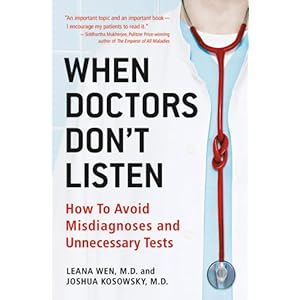
This column is modified from an article published in the American Academy of Emergency Medicine’s magazine, “Common Sense”. I explore these ideas and more in my new book, When Doctors Don’t Listen: How to Avoid Misdiagnoses and Unnecessary Tests.

Have you ever gone to the doctor and felt like he wasn't listening to you? Have you tried to tell your story, only to have him interrupt with a checklist of questions: do you have chest pain, shortness of breath, fevers, cough, and so forth? Have you ever felt ignored, and left thinking that your doctor never understood why came to him in the first place?

The New Year is the time to make changes in your health. If you feel dissatisfied or frustrated by your care, now is the time to figure out how to get better care.

Studies show that 80% of diagnoses can be made based on your history alone. Yet, doctors these days spend less and less time listening. “Cookbook medicine” is prevalent, with doctors resorting to checklists of yes/no questions rather than really listening to what’s going on with you. You have to make sure that your concerns are addressed—and even before that, to make sure your story is heard. Here are 6 tips for getting your doctor to listen to you:

Tip #1: Answer the doctor’s pressing questions first. Many doctors are so accustomed to relying on a checklist of questions that they have to get these answers before they move on. Help them out and answer these questions. If the doctor want you to describe the location of your chest pain, describe it (“it’s in the middle of my chest, right here”). If she want to know what you took to make it better, tell them (“I took an aspirin. It didn’t help”).

Tip #2: Attach a narrative response at the end of these close-ended questions. If your doctor persists on asking close-ended questions, add a narrative response at the end that may not so easily fit into a yes/no answer (“it’s in the middle of my chest, right here, and it started after I really pushed myself in swimming tonight”). Pretend that you are being asked “how” or “why” instead of “yes/no”, and add your own response. Look to make sure your doctor registers this answer—does he ask you more questions to follow-up on what you said, for example?

Tip #3: Ask your own questions. If you don’t understand why a particular question is relevant to your situation, ask about it. You may be surprised to find that the doctor herself isn’t sure and is only asking the question out of habit. On the other hand, you may find out that issues you wouldn’t have thought were related might actually be very important to discuss.

Tip #4: Interrupt when interrupted. If your doctor cuts you off when you try to explain your full answer, free to interrupt. Pretend you’re having a conversation, even when it feels like you’re being interrogated. For example, if you’re asked “when did headache start,” rather than responding “10am,” go ahead and tell your story of how the pain started: “I woke up this morning and I was fine, then I started walking to work and the pain came on suddenly like a lightening bolt striking me.” This is not a new tactic; lawyers will often coach clients in advance to answer yes/no questions with a narrative so that answers can’t be taken out of context. Interrupting is a way to ensure that your entire answer is heard, not just the part that the doctor thinks he wants to hear.

Tip #5: Focus on your concerns. If you get the sense that your concerns are being brushed over, interject, “Excuse me, doctor, I have tried to answer all your questions, but I am still not certain my concerns have been addressed. Can you please help me understand why it is that I have been feeling fatigued and short of breath for the last two weeks?” and so on. You can take charge of the conversation at that point. It’s your body and your duty to advocate for yourself if you don’t feel like your story has been understood and your concerns have been addressed.

Tip #6: Make sure you are courteous and respectful to your doctor. Your doctor is a professional, and is probably trying her best to help you. Your story has to be heard and your concerns addressed, but make sure you present your points in a respectful manner. This will ensure that a solid doctor-patient relationship is present, and is critical to the partnership you need to establish. 

You may be dissatisfied and frustrated by your medical care, but you can take control of your health care and transform your health today. I discuss more in my book, When Doctors Don't Listen: How to Avoid Misdiagnoses and Unnecessary Tests. Try these tips on your next doctor’s visit, and build your partnership for better care.

In my last post, you met Catherine, a young woman who came down with a stomach bug but was ushered through numerous blood tests and a CT scan, only to be even more confused than ever. You saw how shared decision-making needs to begin with the process of establishing a partnership for shared diagnosis, because diagnosis is the first and most critical step to your medical care.

Here are 5 steps to partner for your diagnosis:

#1. Find a physician who agrees with shared decision-making for diagnosis. Your doctor should listen to you, care about you, and feel comfortable—even seek out—involving you as a partner in the decision-making process. You will quickly see whether your doctor gives lip service to the partnership or really believes in it. Someone who really believes in it will work with you and welcome and actively solicit your suggestions. Someone who isn’t will quickly exhibit signs of impatience and defensiveness. If you are always respectful while asking questions, your doctor should welcome the input rather than feel challenged by it.

#2. Express your intentions to your doctor. Doctors aren’t mind readers, and are probably conditioned to patients being passive participants in their healthcare. No matter if this is a new doctor, or one that you’ve had a relationship with for a while, state clearly at the beginning of your visit that you want to be involved as a partner in your own decision-making process. Ask to share in your doctor’s thought process about your diagnosis. Inquire about what it is he/thinks you have. Say that you want to be involved in figuring out what you have and what to do. If your doctor does not respond positively, perhaps it is time to look for another care provider.

#3. Help your doctor help you. Most diagnoses can be made by the story—the history of your illness—alone. Yet, one of the most frequent complaints patients have is that their doctors don’t listen to them. No doubt, there are limitations and pressures on the doctor’s time, but neglecting to listen to you will result in misdiagnoses. You can help make sure your doctor listens to you by telling agood story. Rehearse it in advance and make sure you tell a concise version. Begin at the beginning and proceed chronologically. Provide context, such as how it affected your life. Use your own voice instead of what you think is medical jargon. Write down key details so you don’t forget, and practice the delivery. Knowing how to convey your story effectively is a key part to helping your doctor help you get to the right diagnosis.

#4. Make sure you understand every test that is ordered. Every test should be done for a specific reason. Study after study shows that there is no role for the “screening” test: doing “basic labs” or a “screening CT” is like fingerprinting the entire city to search for a suspect, because it’s ineffective and likely to end up with confusing results. Not to mention that every test, even the basic blood draw, has potential harms (a CT has many more potential harms, including increasing your lifetime risk of cancer). If your doctor asks for lab work to be done, ask what blood work is requested and why. If your doctor asks for a CT scan, x-ray, MRI, etc, ask what it is looking for. How is the test going to change your management? Is it necessary? What are the possible harms? What are the alternatives? These are the same questions you would ask if you were deciding whether to treat and how to treat your illness, and making the diagnosis should be no different.

#5. Make decisions together, always with the diagnosis in mind. A test or procedure should be done only if it helps make your diagnosis; otherwise, what’s the purpose? The treatment should be targeted to the diagnosis; otherwise, what is it being done for? Perhaps there are two or three possible diagnoses; what is going to be done to try to narrow this down? What’s the natural course of the illness; what should you expect and what can you do to start feeling better? You need to be proactive in thinking through and asking questions, and if you have a willing physician (as you should), you should have all of your questions answered. Keep asking if your diagnosis does not make sense to you.

A critical component of shared decision-making is to work with your doctor to figure out your diagnosis. Focusing on this first, key part of your care will have transformative effects on your health.

Imagine, how different would it have been if Catherine were involved in the very beginning with her diagnosis. She would have been able to tell her story and ensure her doctors listened, which could have led to the diagnosis without any tests at all. She would have avoided an unnecessary CT scan and unnecessary blood work, along with the all the potential harms and confusion of the tests. She would have received her diagnosis and understood what it is and how to treat it. She would have gone home, reassured and feeling better.

You may be dissatisfied and frustrated by the way your medical care is today, but there is a way to make it better. You hold the key to transforming your health. Try it on your next doctor’s visit, and focus on shared decision-making towards making your diagnosis.

Tried it? Have suggestions? I welcome your comments!