


Danielle is a 21-year-old woman with a headache. Her doctor tells
her that she needs a CT scan and a spinal tap. Danielle doesn’t want
these tests; she knows that she drank too much last night and feels like
she has a bad hangover, but should she really say no to her doctor?
Nancy is a 38-year-old woman with vomiting and diarrhea. Her
toddlers have the same symptoms. The doctor says she needs to get a CT
scan of her belly. He says her blood pressure is “borderline high” and
that she should also start taking medication. She’d prefer to avoid
drugs if possible—what should she do?
As an emergency physician, I see dilemmas like these every day, yet
they get very little attention. For so long, the rhetoric has been about
the danger of too little medical care. Newspapers are full of
stories about deaths that have resulted from missed diagnoses and lack
of access to care. TV shows glorify the detective-doctor who doesn’t
give up and persists on ordering test after test in order to solve an
esoteric case.
While many people still lack access to care, there’s mounting evidence that many people also receive too much care. The prestigious Institute of Medicine estimates that 30 percent of all medical tests and treatments are unnecessary. This is not only wasted money—an estimated $700 billion of unnecessary spending per year—but also potentially harmful. Every test has risks and possible side effects. A CT scan has a risk of radiation, for example, that may lead to cancer later in life. And one test often leads to another, even riskier, test.
There are many causes of overtreatment. Drug companies and technology
manufacturers have their own incentives for wanting people to receive
more, rather than less, care. While doctors generally mean well, they
also have financial incentives for over-testing. A study in the New England Journal of Medicine found that 94 percent of doctors have some relationship with a drug company or medical device company, and many are paid more for conducting more tests. On top of that, fear of malpractice can also drive doctors to do more, just to be sure.
The problem isn’t just doctors, though. Patients also believe that
more is better. New tests and treatments succeed in part because the
general public tends to idolize technology.
Unfortunately, this issue is
complicated because medical advances can be helpful and save
lives in certain circumstances. So how do you know when testing is
appropriate—and when it’s simply too much?
There isn’t an easy answer to this question, but I recommend that you
ask your doctor five key questions every time he or she recommends you
undergo a test:
What Do You Think My Diagnosis Might Be?
Your doctor always has some sense of possible diagnoses
before you get any tests done. You should find out what he or she is
thinking; that way, you know why the tests are being done and how likely
the various possibilities are. If Danielle had asked her doctor this,
for example, he likely would have told her that odds are she just has a
hangover and that it’s far less than a 1 percent chance that she has
brain bleeding.
What Evidence Exists Suggesting this Test or Treatment is Beneficial?
This is particularly important for screening tests like checking for
high blood pressure, cholesterol, and cancer. Ask your doctor what
studies there are to show that a test improves quality of life. If there
is no evidence for the test or if the jury is still out, you should ask
why your doctor thinks you need the test and keep in mind your doctor’s possible incentives for testing and treatment.
What are the Potential Side Effects?
Every single test, even just getting your blood drawn, has side
effects—and you should know what they are before you consent to any
tests. Without knowing the side effects, you can’t weigh the risks
against the benefits.
Is Watching and Waiting an Option?
Very few situations are so urgent that a test has to be done ASAP; most of the time, it’s perfectly fine to wait and see
if other symptoms emerge or if you get better. With Nancy, for example,
it would have been appropriate for her to go home and see if she gets
better; she didn’t need to get a CT scan right away.
What Other Treatment Options Do I Have?
Doctors are trained to “fix” problems with treatments. Many of us don’t
have the knowledge or time to counsel patients on other options, like diet
and exercise changes and/or alternative treatments. But these other
treatments may be just as effective and may help you avoid potentially
harmful side effects. Perhaps Nancy’s blood pressure could be controlled
with diet alone, for example. There are always alternatives; ask about
them.
Ultimately, you should have a trusting partnership
with your doctor and feel comfortable asking hard questions. You are
your own best advocate, and you have to speak up to make sure you get
the right medical care—and avoid unnecessary tests and treatments.
This article was previously published in Women's Health
Magazine (posted here with their permission).
Showing posts with label overtreatment. Show all posts
Showing posts with label overtreatment. Show all posts
3


by Sonia Gow
About 20 years ago I was ill with a mystery ailment.
The symptoms were flu-like and I felt totally drained of energy. My doctor said
he couldn't help me because he didn't know what I had, how I got it, how long I
would have it, or how I could feel better. Basically, I was on my own.
This was the beginning of my journey to figure out
how I could regain and maintain my good health. I read everything I could about
it, altered my diet and exercised. Then, because I enjoyed the exercise and I
felt so much better, I became a fitness professional so I could help others
enjoy exercise and feel better, too.
I was supposed to work with healthy people but
because my focus is working with people over 50 years of age, I never met any.
Most "boomers" are taking at least one prescribed medication, and
frequently many more, usually related to hypertension or cholesterol. For the
past few years I've been working primarily with people living with Parkinson's
disease and they are prescribed numerous medications, as are many of their
partners or caregivers.
Because of all the medical care my friends receive,
there are lots of stories about their visits to the doctors and about their
treatments, but what really hits home with me is how this all affects their
lives. How their activities are limited or the time it takes for medical
appointments. There are family activities and other fun things they miss out on.
I recently heard this referred to as "missed opportunities".
While
the physical, emotional, and financial aspects are easily acknowledged as
having value, these lost opportunities frequently are not. But they do have
value. They are about our lives.
Recently I discovered several books written by
doctors and journalists about overdiagnosis
and overtreatment,
and they confirmed what I already suspected - that people were not only being
tested and treated unnecessarily but that some were being harmed, too. They
thought they were doing the right thing by following their doctors' orders but
were unaware of the harms or that there might be other options, and they were
unnecessarily enduring additional hardship.
What is wonderful about Dr. Wen's book, When Doctor's Don't Listen: How to
Avoid Misdiagnoses and Unnecessary Tests, is that she not only explains
the problems but offers user-friendly suggestions on how to speak up and work
with your doctor to ensure that you receive the treatment you need for the
ailments you have and avoid medical treatment for the ones you don’t have
I am so pleased to see that more awareness is being
directed to overdiagnosis and overtreatment. I started writing a blog, Patients Are People Too, to direct
other patients to the information that's out there so they can make better
decisions. .
I never did get a definitive
answer about my mystery ailment from any of the doctors I've seen over the
years, so I guess the first one did me a favor. Because of him, I've been able to
figure out what works best for me. I hope you'll be encouraged to do the same.
Sonia Gow is a patient—and person—and
blogs at patientsarepeople.com.
Our healthcare system is broken and in dire need of
reform. We all know the statistics: the U.S. spends $2.7 trillion on healthcare, 30% of which is waste in the form of unnecessary tests and unnecessary
treatments. Conflicts of interest are rampant, with 94% of doctors reporting an affiliation with a pharmaceutical or device manufacturing
company, and many more insidious influences including salaries being tied to “productivity”. Dozens of studies have shown that these conflicts of interest have a real impact on care, and are a major driver
of excessive cost and avoidable harm.
On my recent book tour, I discovered an even bigger problem
than the cost of care. There is a rampant and growing epidemic that we seldom
discuss—the epidemic of fear. It’s understandable why patients are scared when
they come to us. They’re not feeling well. They’re scared of what might happen.
But there’s another layer
of fear, one that begins and ends with trust. When my mother
was diagnosed with metastatic cancer, it took her months
to find an oncologist she liked. One day, while trying to locate his office
number online, she found a listing for him as a highly-paid consultant and
speaker for a drug--the same chemotherapy drug that he’d put her on. This might
have still been the right treatment for her, but it made her wonder, and it
made her scared.
Traditionally, medicine has maintained a certain
mystique. While there has always been information asymmetry, patients and
doctors established longstanding relationships, and patients trusted that
doctors had their best interests at heart. However, today’s medical landscape
is very different. Few patients have longstanding relationships with their
doctors. They have little to go on when deciding who to trust with their
health, then are kept in the dark on matters ranging from cost of care to
doctors’ motivations to necessity of tests and treatments.

In a time when they are already vulnerable and
scared, patients have become even more afraid that they may not be receiving
the right care for the right reasons. Doctors, too, have become afraid of their
patients; much has been written about the fear of malpractice leading to hiding mistakes and practicing defensive medicine.
This mutual fear has led to distrust, disconnection
and poor medical care. The driver of fear is secrecy and shame, and the
antidote is honesty and transparency. Doctors are public servants whose duty is
to be accountable to our patients. We need to break through the barrier of fear
by sharing with our patients and the public who we are.
This is why I'm starting a new campaign, “Who’s My Doctor? The
Total Transparency Manifesto.” Participating doctors produce a
voluntary, public disclosure statement that includes the following: revenue
streams of all payments, salary contribution and how salary is determined (i.e.
hourly, RVU system, incentive/bonus), paid and unpaid board membership,
investments, volunteer activities, professional interests, hobbies, and philosophy
of practice.
Doctors already disclose much of this information
when they apply for jobs and when they submit to medical journals. So why
shouldn’t this information also be available to the public? Our patients have a
right to know what influences their doctors may have that affect their care. It
holds doctors accountable to our patients while at the same time humanizing us
and reinforcing our role as socially responsible public servants.
Many patients may well decide that this information
is irrelevant and never look at it. However, it should be available in a
public, easily searchable database for those who do think it matters. Patients
then have the option of identifying a doctor whose philosophies match their
own. They can also help to encourage their doctor to participate in this
project.
Many doctors may have qualms about their information
being available in such a public forum. However, in the era of Google and
social media, much of this information can already be found online, and having
a voluntary disclosure gives more control to the doctor. Also, experience with
other transparency pilots such as Open Notes has
demonstrated that openness leads to better communication, more trust, and
better care, and it only follows
that a more open relationship with our patients leads to less fear and less
malpractice.
I believe that this form of radical transparency is
paradigm changing. It is changing the culture of medicine from one of secrecy
and mystery to one that is totally open to patients. It is a public
demonstration that patient interests are primary, that reaffirms the reasons
why each of us went into medicine. Every time I tell my patient about my
decision to be a totally transparent doctor, every time I share my Total Transparency
Manifesto, I are saying, I’m your doctor. I’m looking out for you. I’m
free of influence that could affect you. Don't be afraid of me; trust me. I’ll
be vulnerable with you.
Over the last few weeks, I’ve been discussing this
idea with my colleagues and my patients. So far, I have myself and 10 other
doctors who are willing to be totally transparent doctors. I’d love to have
doctors of all specialties to participate, to say, I’m doing what I can to
restore professionalism and break down the barrier of fear.
I’d love to have you join us. What you need to commit
to is to write a Total Transparency Manifesto for the website (full website
TBA; see more information and my manifesto on my webpage), tell your patients about it, and
share your experience with me and the readers on this blog. How did it make you
feel. Scared? Uncomfortable? Defensive? Liberated? And how did your patients
respond?
And patients—what do you think? Please post your
responses. Over the next few months, I’ll be posting my own experiences as well
as the experiences of my fellow transparent doctors and our patients. Please
join us in this new mission to counter fear and restore trust.
In my last two blog posts, I discussed the harms of a new epidemic: too
much medical care. We also don’t want the opposite, of enough care care. In
fact, much of the driving force leading to overdiagnosis and overtreatment is
this fear of rationing.
So what can you do to ensure that you obtain just the right
amount of care?
It isn’t easy—if it were, if there an algorithm that would
give us the answer, then we wouldn’t have the Goldilocks problem (“Is it too
little? Too much?”).
Here are 5 suggestions that may help:
First and foremost, work
in partnership with your doctor. The most critical key to getting good
medial care is a trusting relationship between you and your doctor. This is not
to say never question your doctor; but rather, develop a relationship of mutual
respect such that you are the expert when it comes to your body, and the doctor
is the expert when it comes to medicine.
Second, make
sure your doctor listens. Study after study shows that the patient history
will reveal the diagnosis in 80%
of the cases, without the need for any tests or further interventions. If
your doctor orders tests instead of listening to your story, that leads to
unnecessary testing—and potential misdiagnoses. Prevent this by telling a good
story, and making sure it’s heard.
Third, ask
about your diagnosis. Understanding what you have is key to figuring out
what should follow. Before you get any tests done, ask your doctor what he
thinks you might have. This gives you some idea of what tests may be necessary,
and also focuses your doctor to remember the important tests and have a
justification for tests ordered.
Fourth, ask
about every test done. Every single test has risks, so make sure you
understand why each test is done. Ask about the risks. Ask about how it would
change management: what happens if it’s negative? What happens if it’s
positive? And, importantly—what happens if nothing is done at all? This helps you
gauge how emergent (and also how necessary) a particular test is at this point
in time.
Fifth, do your own research. This is particularly true when
it comes to treatments. Look on the Internet and ask your friends and family.
Be aware that not all information is equally credible, but at least this helps
you formulate questions to ask your doctor. It might also help to look up your
doctor and see if she has conflicts of interest that you may not be aware of: information
about drug company affiliations, for example, can be found online. Write down
questions, and ask them.
None of these suggestions are foolproof. These five steps
can help begin the process for you and your doctor to work together to identify
the right tests and treatments for you. If you have other thoughts or ideas
that work, please write your comments below.
One of the many takeaways from the recent Preventing Overdiagnosis
Conference is that it’s hard for doctors to tell their patients that too
much care is bad.
For so long, the rhetoric has been about the danger of too little care. Newspapers brim with
stories of death from missed diagnosis and lack of access to care. TV shows
glorify the detective-doctor who doesn’t give up and persists on ordering test
after test in order to solve an esoteric case.

Over the last decade, there is mounting evidence
illustrating the harms of overdiagnosis
and overtreatment.
Risk factors have been turned into diseases, and diseases are being created for
the purpose of selling medications. Dartmouth’s Dr. Lisa Schwartz told the
story of how GlaxoSmithKline created
a new disease entity—restless leg syndrome—to find a new use of an existing
medication that was going off patent. American Cancer Society’s Chief Medical
Officer Dr. Otis Brawley discussed how hospitals
offer “free” screening tests knowing that they will lead to false
positives, thus creating a market for further testing and more care.
Who is to blamed for “selling
sickness”? No doubt, big pharma and hospital corporations are culpable.
They feed into patients’ fears. Maybe your doctor hasn’t heard of this “new”
disease. Maybe she has financial incentives to prescribe you the rival
medication. Why not take control of your health, and heed the advertisements to
“ask your doctor about” the latest medication and the full-body CT scan?
There is another party that is just as guilty in the crime
of disease mongering. It is doctors who are complicit with drug companies by
speaking about “new” diseases and prescribing unnecessary medications. It is
doctors who are complicit with hospitals by ordering unnecessary tests. It is
doctors who instilled in our patients the blind faith in technology and the
boundless optimism in treatments.

Combating overdiagnosis must begin with doctors
acknowledging that we are part of the problem. The foundation of medical care
is trust, and this trust is being eroded by financial incentives and conflicts
of interest. We need to address this and reassure our patients that we are
fully on their side.
Just as our profession stepped up to address critical issues
such as access to care and medical error, we must have the courage to admit our
contribution to the growing health threat of too much care. This will not be
easy—but we must have the courage to reinstill trust, and do what’s right by
our patients and our society.
****
This article previously appeared in and reposted with permission from British Medical Journal's blog.
I just returned from a thought-provoking conference at
Dartmouth. Entitled Preventing
Overdiagnosis: Winding Back the Harms of Too Much Care, and co-sponsored by
Dartmouth University, British Medical Journal, Consumer Reports, and
Australia’s Bond University, the conference raised many points that are rarely
discussed.
Here are some of my favorite quotes:

“Risk factors have
been turned into diseases.” Dr. Steve Woloshin discussed the absurdity of
labeling us all with a “pre-disease”: doesn’t everyone all have some version of
pre-hypertension, pre-diabetes, or even pre-death? More insidious is the promulgation
of testing people who have no symptoms, despite of evidence of harm. American
Cancer Society’s Chief Medical Officer Dr. Otis Brawley discussed how hospitals
offer “free” screening tests knowing that they will lead to false
positives, thus creating a market for more testing and more care.
“Diseases are being
created for the purpose of selling medications.” Dr. Lisa Schwartz told the
story of how GlaxoSmithKline created
a new disease entity—restless leg syndrome—to find a new use of a
Parkinson’s disease medication that was about to go off patent. Roy Moynihan
showed his class spoof video
of a new and dangerous epidemic.
“Ordinary experience
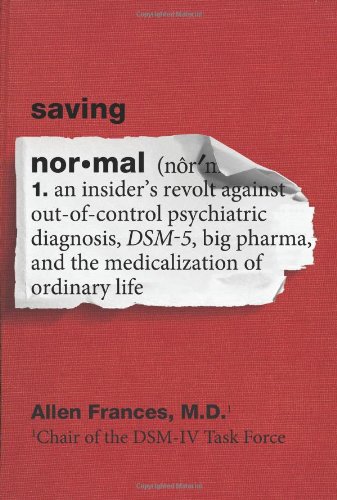
is medicalized.” Dr. Allen Frances, a psychiatrist and Chair of the DSM4
task force, rails
against the psychiatric profession for labeling people with diseases they
don’t have. If you are grieving two weeks after the death of a spouse, you have
depressive disorder; if your child is inquisitive and energetic, he has
attention deficit disorder. Of course, watchful waiting is never the solution,
but fortunately, there is a new and expensive medication for this disease.
“Language corrupts
thought.” A diagnosis of “carcinoma-in-situ” brings up scary connotations
and fuels the desire for aggressive treatment. However, our technologies have
gotten so advanced that we are detecting many early cancers that, if left
alone, may never grow or harm the patient. The National Cancer Institute
recently proposed a change in
terminology for cancer, and other conference speakers proposed other disease
definitions that should be changed.
“We are practicing
faith-based medicine that ignores the harms and exaggerates the benefits.”
It is well-documented that medical journals
bias in favor of positive results, and that there are many financial
interests to promote the newest, latest medication or treatment. Stories abound
about people who survived because of early detection of disease and new, experimental
treatment. However, there are also many stories of people who experience
serious side effects and fatalities from overdiagnosis
and overtreatment.
These counternarratives need to be told, and evidence for harm needs to be
published.
“Overdiagnosis is a
symptom of the same problem that drives underdiagnosis and misdiagnosis.”
In the discussion of overdiagnosis, it’s important not to forget that there are
other pressing issues too, including medical error and lack of access to
healthcare. The medical industrial complex is at fault here, too, and doctors
need to assume our social
responsibility and moral imperative to do what’s best for our patients.
“More care isn’t
better care; it’s just more care.” In the words of my hero, cardiologist
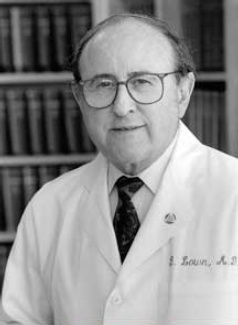
and Nobel Peace Prize winner Dr. Bernard Lown: “Overtreatment harms patients, thereby negating the first
principle of doctoring, primum non nocere.” Our goal in
medicine should be to do “as much as possible for the patient, as little as possible to the patient.”
There will be many challenges ahead for conference
attendees, including the difficulty of framing and discussing the problems of
overdiagnosis and overtreatment. Much of this conversation will continue at the Lown Institute's Right Care Alliance conference in December. My next few blog articles will address these
difficulties. Stay tuned, and please feel free to contribute your thoughts
below!
Subscribe to:
Posts (Atom)
